


Researchers at Göttingen University Medical Center (UMG) and the Max Planck Institute (MPI) for Multidisciplinary Sciences have elucidated how the production of certain proteins and their incorporation into the inner membrane of mitochondria – the ‘powerhouses of the cell’ – are coordinated. This process, which ensures energy production in living cells, can cause serious diseases in humans if it malfunctions. The new regulatory mechanism provides a better understanding of the causes of neuromuscular diseases. The findings have been published in the journal “Nature Structural & Molecular Biology”.
A team led by MBExC member Prof. Dr. Peter Rehling, Director of the Institute of Cell Biochemistry at UMG, and Dr. Niels Fischer, project group leader at the MPI for Multidisciplinary Sciences, has now shown that mitoribosomes do not produce membrane proteins at a constant rate, but rather according to a precisely timed choreography. “We were able to show when the ribosome pauses,” explains Dr. Schöndorf, first author and postdoctoral researcher in Prof. Rehling’s team.
You can find the press release (in German) here.
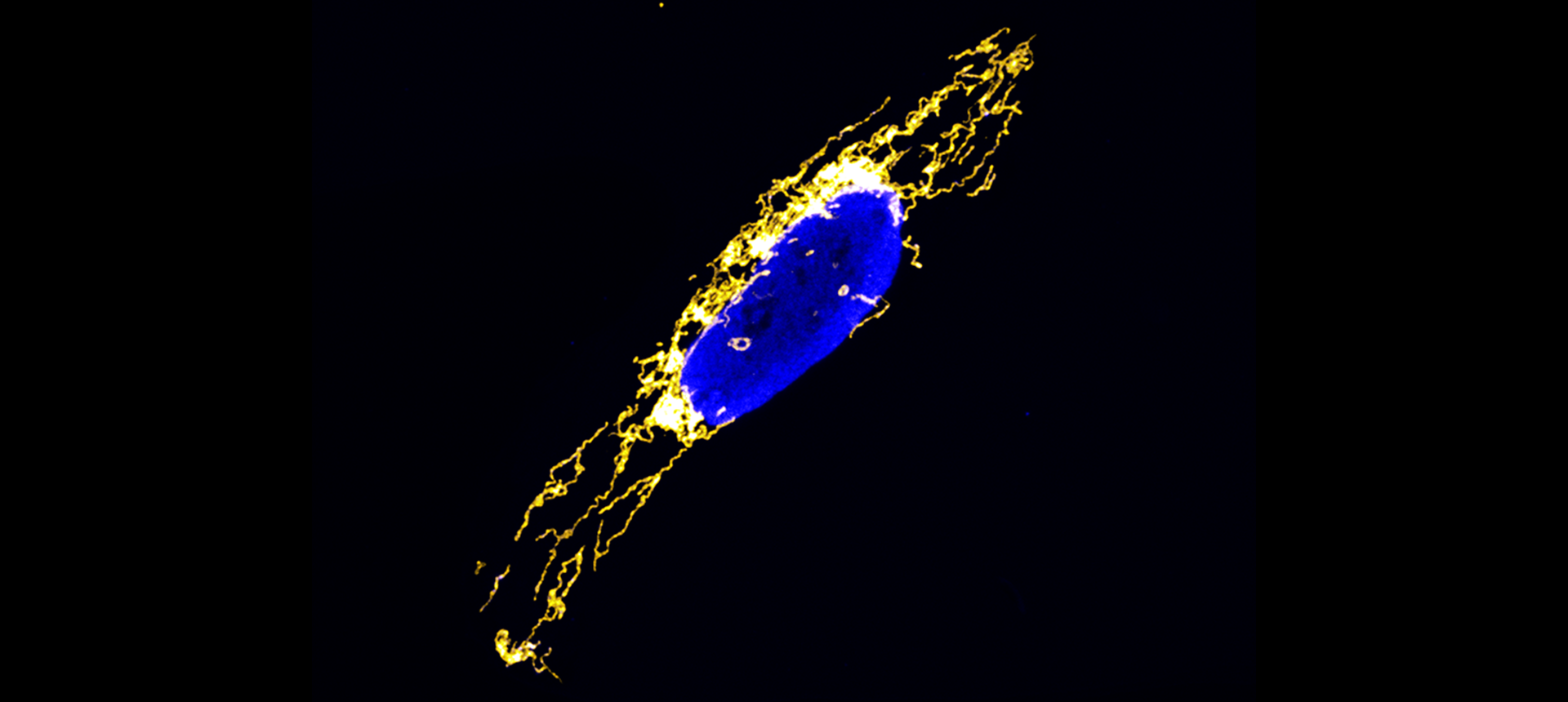
Human cell showing a network of mitochondria (yellow) and the cell nucleus (blue). Image: umg/Peter Rehling
