


Biomolecules, also known as organic molecules, include sugars, proteins and lipids and are the building blocks of all life. They play a role in the structure and metabolism of all living organisms. To make them visible under a microscope, researchers use special dyes to make them glow. A research team at the University of Göttingen has now developed a new method to do this better. Unlike conventional approaches, the luminescent dye is not added to the sample as a ready-made product. Instead, it only begins to glow as it binds to the target molecule. This solves the old problem of pre-made dyes remaining in the sample even when they are not bound to the target molecule, which interferes with imaging. The research was published in the journal Angewandte Chemie International Edition.
The new method means that the luminescent dye only glows when the labelling has been successful. This makes experiments with biomolecules clearer and easier to interpret. PhD researcher at Göttingen University, MBExC member and first author on the study, Dongchen Du says: “Our work takes a practical approach: instead of attaching a ready-made fluorophore, we build the fluorescent label directly where it is needed. For me, that makes chemistry both beautiful and useful!”
You can find the press release here.
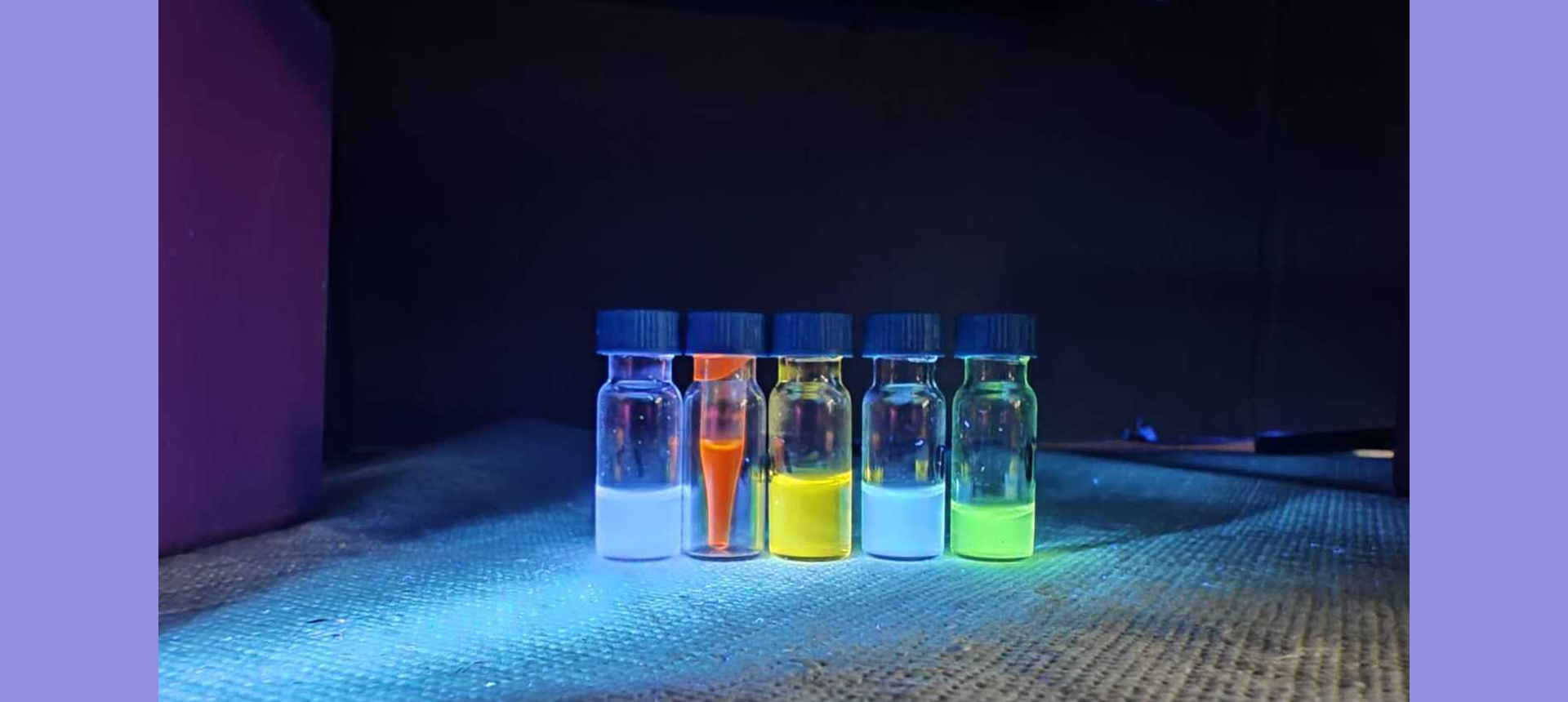
Different luminescent dyes. Photo: Dongchen Du
