


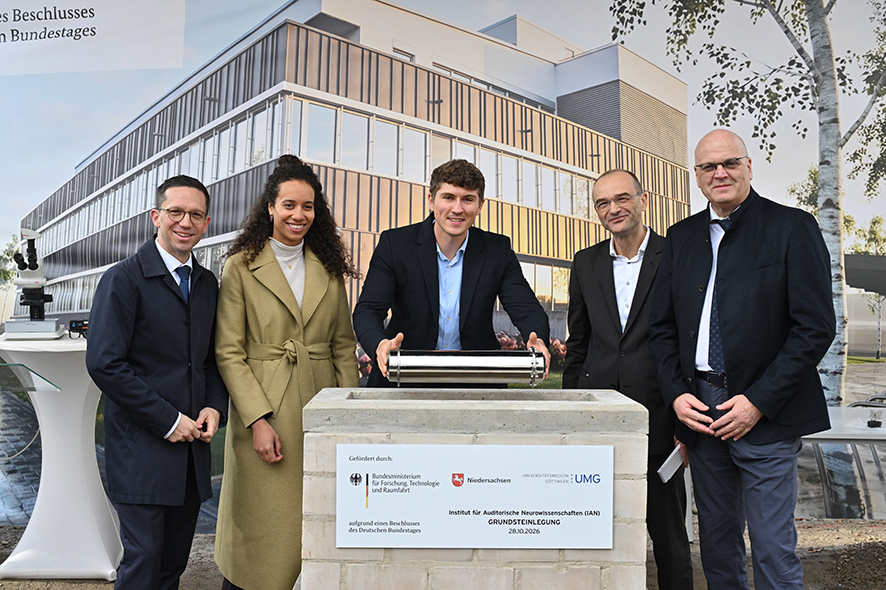
The cornerstone for the new research building, the Institute for Auditory Neuroscience (IAN) at the University Medical Center Göttingen (UMG), was laid on Wednesday, October 28, 2026, at Robert-Koch-Straße 8 in Göttingen, in the presence of Falko Mohrs, Lower Saxony’s Minister of Science and Culture. In the new building, the fundamentals of hearing will be unraveled, and future gene therapy methods as well as medical devices for restoring hearing will be developed. Closely linked to the IAN’s research is the Else Kröner Fresenius Center for Optogenetic Therapies (EKFZ OT). The goal is to translate optogenetic methods from basic research into therapeutic applications. The state of Lower Saxony has allocated approximately 38.5 million euros for the construction. The building is scheduled to be completed and put into operation by the end of 2028, so that it can be occupied in 2029.
In their remarks at the cornerstone-laying ceremony, the speakers emphasized the importance of hearing research in Göttingen. Falko Mohrs, Lower Saxony’s Minister of Science and Culture, said: “Hearing means participating in life. People who have difficulty hearing or are losing their hearing often face significant challenges in their daily lives. Even before this year’s Nobel Prize in Medicine was announced, Göttingen’s outstanding research had already demonstrated the potential of optogenetics for medical care. With the new Institute for Auditory Neuroscience, we are strengthening a field of research that can improve the lives of many people. The fact that leading researchers will collaborate under one roof in the new research building creates the ideal conditions for developing new treatment options more quickly and thereby providing tangible help to those affected.”
“In the new UMG building, expertise in hearing research will be brought together under one roof across three floors. Research groups that are currently located at different sites on the Göttingen Campus will conduct joint research here in the future. Short distances, direct collaboration among multidisciplinary researchers, and the shared use of research infrastructure—such as highly specialized laboratory equipment—will contribute significantly to advancing the restoration of hearing. People worldwide will benefit from this research,” said Prof. Dr. Wolfgang Brück, Spokesperson for the Executive Board and Executive Director of Research and Teaching at UMG.
“The focus in the new research building will be on hearing and new therapeutic approaches for hearing loss. Having made a significant contribution to the development of the first gene therapy for the ear, our primary focus is now on developing the optogenetic cochlear implant. With this technology, also known as ‘hearing with light,’ light pulses specifically stimulate the auditory nerve. This promises a better hearing experience than with conventional electrical cochlear implants,” added Prof. Dr. Tobias Moser, Head of the IAN at UMG. “In addition, we will work closely with the other research groups at the EKFZ OT that are developing optogenetic therapies for the treatment of blindness, gastroparesis, and mobility impairments.”
Press contact:
University Medical Center Göttingen, University of Göttingen
Head Corporate Communications
Lena Bösch
Von-Siebold-Str. 3, 37075 Göttingen
Phone +49(0)551 / 39-61020
Fax +49(0)551 / 39-61023
presse.medizin[at]med.uni-goettingen.de
www.umg.eu
Link to the UMG press release (in german)
