


International research team led by Göttingen University design versatile imaging system
Understanding how cells are organized and how their molecular components interact in a coordinated and cooperative manner is a central goal of modern life sciences. To answer these questions, researchers need to observe many structures inside the same cell at once and map how they are arranged and interact. This requires “multiplexed super-resolution microscopy” – an advanced imaging approach that reveals cellular details far beyond the limits of conventional light microscopes. However, existing methods are often technically demanding, difficult to reproduce, and not well suited for fragile biological samples. An international research team led by the University of Göttingen, together with the University Medical Center Göttingen (UMG), as part of the Göttingen Cluster of Excellence “Multiscale Bioimaging: From Molecular Machines to Networks of Excitable Cells” (MBExC), set out to overcome these limitations. The team developed a dedicated microfluidics system that makes multiplexed super-resolution microscopy easier, more reproducible, and accessible to a broader community. The work was published in the journal ACS Nano.
You can find the press release here.
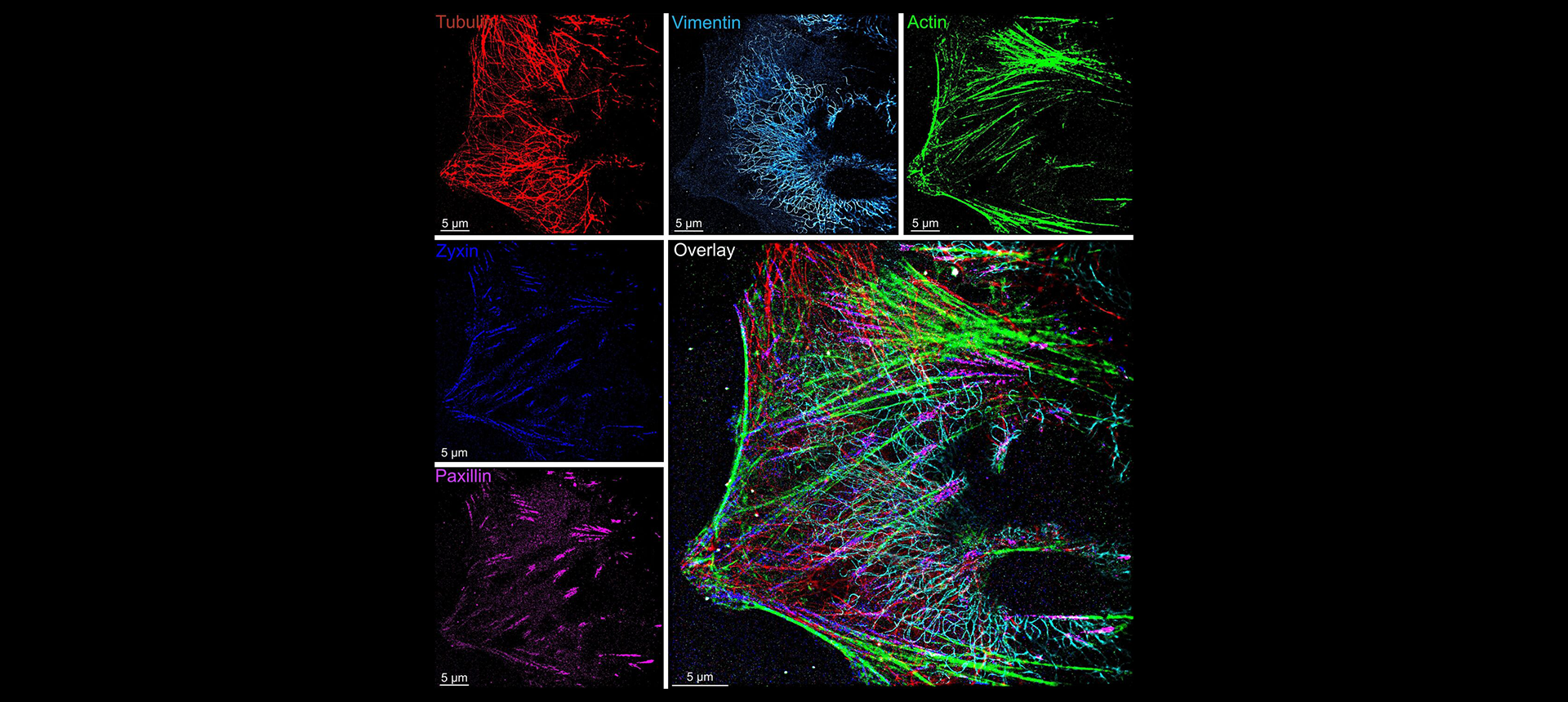
Super-resolution image of cytoskeleton and focal adhesion proteins taken using the new versatile and cost-effective microfluidics system. The “overlay” of all the different target molecules reveals exquisite and complex detail up to 100 times sharper than conventional microscopy. Photo: adapted from the original publication in ACS Nano (2026). DoI: 10.1021/acsnano.5c18697
