08.04.2025
Authors Jeremias J, Pape C Journal Methods in Microscopy Citation Methods in Microscopy, 2025. Abstract Counting objects is an important task in biomedical image analysis, for example to count cells in microscopy or microbial colonies in laboratory applications. Similar to most image analysis tasks, modern approaches to counting rely on
08.04.2025
Understanding inherited cardiomyopathies: clinical aspects and genetic determinants
Authors Yigit G, Kaulfuß S, Wollnik B Journal Medizinische Genetik Citation Med Genet. 2025 Apr 8;37(2):103-111. Abstract Cardiomyopathies (CMs) are a clinically heterogeneous group of cardiovascular diseases characterized by structural and functional abnormalities of the heart muscle in the absence of coronary artery disease, hypertension, valve disease, or congenital heart
07.04.2025
Pioneering partnership shaping the future of regenerative cardiac medicine
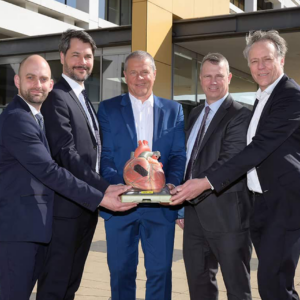
With the signing of an equity agreement on April 2, 2025, biotech pioneers Repairon GmbH and life science investor Bioventure Management GmbH, both based in Göttingen, have entered into a strategic partnership with the potential to fundamentally change the treatment of heart failure worldwide. Bioventure is investing in Repairon –
07.04.2025
Modulation of protein activity by small RNA base pairing internal to coding sequences
Authors Thongdee N, Alaniz MM, Samatova E, Zhong A, Esnault C, Zhang H, Dale RK, Rodnina MV, Storz G Journal Molecular Cell Citation Mol Cell. 2025 Mar 30:S1097-2765(25)00258-8. Abstract Most characterized interactions between bacterial small RNAs (sRNAs) and their target mRNAs occur near ribosome binding sites, resulting in changes in
04.04.2025
Recent developments in multiple sclerosis neuropathology
Authors Stadelmann C, Franz J, Nessler S Journal Current Opinion in Neurology Citation Curr Opin Neurol. 2025 Apr 4. Abstract Purpose of review: Neuropathological studies in human brain tissue are indispensable for our understanding of disease mechanisms in multiple sclerosis (MS). They inform concepts of lesion evolution, tissue regeneration and
03.04.2025
Nadja Simeth-Crespi appointed as W2 professor of Molecular Labeling Chemistry
Congratulations to MBExC member Nadja Simeth-Crespi on her appointment as W2 Professor of Molecular Labeling Chemistry at the University of Göttingen! Prof. Simeth-Crespi and her team’s research intersects the boundaries of bioorganic and photochemistry, with a focus on the design of smart drugs, biochemical probes and labels, as well
02.04.2025
Power-law adaptation in the presynaptic vesicle cycle
Authors Mikulasch FA, Georgiev SV, Rudelt L, Rizzoli SO, Priesemann V Journal Communications Biology Citation Commun Biol. 2025 Apr 2;8(1):542. Abstract After synaptic transmission, fused synaptic vesicles are recycled, enabling the synapse to recover its capacity for renewed release. The recovery steps, which range from endocytosis to vesicle docking and
31.03.2025
Direct Stimulation of Gastric Smooth Muscle Cells via Gq Proteins With Light
Authors Zipf D, Vogt M, Sathyanarayanan U, Wagdi A, Riebeling J, Patejdl R, Bruegmann T Journal Neurogastroenterology and Motility Citation Neurogastroenterol Motil. 2025 Mar 31:e70028. Abstract Background: Optogenetics is a cutting-edge approach that can enable direct stimulation of gastric smooth muscle cells (SMC) by combining cell-specific overexpression of light-sensitive proteins
28.03.2025
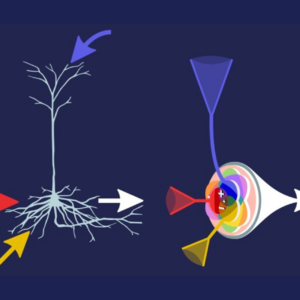
Artificial neurons organize themselves
Göttingen research team constructs network of self-learning infomorphic neurons Novel artificial neurons learn independently and are more strongly modeled on their biological counterparts. A team of researchers from the Göttingen Campus Institute for Dynamics of Biological Networks (CIDBN) at the University of Göttingen and the Max Planck Institute for
27.03.2025
Understanding mitochondrial protein import: a revised model of the presequence translocase
Authors Jain N, Chacinska A, Rehling P Journal Trends in Biochemical Sciences Citation Trends Biochem Sci. 2025 Mar 27:S0968-0004(25)00050-7. Abstract Mitochondrial function relies on the precise targeting and import of cytosolic proteins into mitochondrial subcompartments. Most matrix-targeted proteins follow the presequence pathway, which directs precursor proteins across the outer mitochondrial