23.06.2022
At its meeting on 23 June 2022 in Berlin, the Max Planck Society’s Senate unanimously appointed MBExC member Patrick Cramer as new President-elect of the Max Planck Society for the term of office from 2023 to 2029. The chemist and molecular biologist currently serves as Managing Director at the Max
22.06.2022
Adventures and Advances in Time Travel With Induced Pluripotent Stem Cells and Automated Patch Clamp
Authors Rosholm KR, Badone B, Karatsiompani S, Nagy D, Seibertz F, Voigt N, Bell DC Journal Frontiers in Molecular Neuroscience Citation Front Mol Neurosci. 2022 Jun 22;15:898717. Abstract In the Hollywood blockbuster “The Curious Case of Benjamin Button” a fantastical fable unfolds of a man’s life that travels through time
22.06.2022
Not the classical serendipity: does doxapram treat atrial fibrillation?
Authors Liutkute, A, Brundel BJ, Voigt, N Journal Cardiovascular Research Citation Cardiovasc Res. 2022 Jun 22;118(7):1613-1614. Abstract No abstract available DOI 10.1093/cvr/cvac044 Pubmed Link
22.06.2022
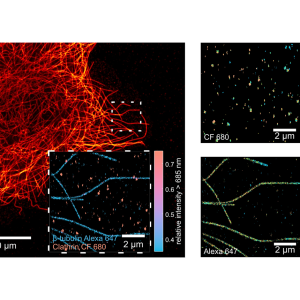
3D imaging with super resolution on the nanometre scale
Despite vast improvements in microscopy, there is still a remarkable gap between resolution in all three dimensions. A research team led by MBExC member Jörg Enderlein (University of Göttingen) together with researchers from the University of Würzburg and the Center for Cancer Research (USA), has investigated a technique for super-resolution
21.06.2022
Aging-Associated Changes in Cognition, Expression and Epigenetic Regulation of Chondroitin 6-Sulfotransferase Chst3
Authors Baidoe-Ansah D, Sakib S, Jia S, Mirzapourdelavar H, Strackeljan L Fischer A, Aleshin S, Kaushik R, Dityatev A Journal Cells Citation Cells 2022, 11(13), 2033. Abstract Understanding changes in the expression of genes involved in regulating various components of the neural extracellular matrix (ECM) during aging can provide an
20.06.2022
Calpain cleavage of Junctophilin-2 generates a spectrum of calcium-dependent cleavage products and DNA-rich NT1-fragment domains in cardiomyocytes
Authors Weninger G, Pochechueva T, El Chami D, Luo X, Kohl T, Brandenburg S, Urlaub H, Guan K, Lenz C, Lehnart SE Journal Science Reports Citation Sci Rep. 2022 Jun 20;12(1):10387. Abstract Calpains are calcium-activated neutral proteases involved in the regulation of key signaling pathways. Junctophilin-2 (JP2) is a Calpain-specific
20.06.2022
MBExC at the “Tag der Niedersachsen” (“Day of Lower Saxony”) 2022
Almost 500,000 visitors celebrated with about 250 exhibitors on 9 theme miles in Hanover on the “Tag der Niedersachsen” (“Day of Lower Saxony”) from July 10-12 – and the MBExC was there with various exhibits to present the fascinating multiscale heart and brain research to a broad public. link to
18.06.2022
Structural and mechanistic basis of RNA processing by protein-only ribonuclease P enzymes
Authors Bhatta A, Hillen HS Journal Trends in Biochemical Sciences Citation Trends Biochem Sci. 2022 Jun 18:S0968-0004(22)00139-6. Abstract Ribonuclease P (RNase P) enzymes are responsible for the 5′ processing of tRNA precursors. In addition to the well-characterised ribozyme-based RNase P enzymes, an evolutionarily distinct group of protein-only RNase Ps exists.
16.06.2022
The Statistics of Circular Optimal Transport
Authors Hundrieser S, Klatt M, Munk A Journal Directional Statistics for Innovative Applications Citation SenGupta, A., Arnold, B.C. (eds) Directional Statistics for Innovative Applications. Forum for Interdisciplinary Mathematics. Springer, Singapore. Abstract Empirical optimal transport (OT) plans and distances provide effective tools to compare and statistically match probability measures defined on
15.06.2022
Extracellular alpha-synuclein: Sensors, receptors, and responses
Authors Domingues R, Sant’Anna R, da Fonseca ACC, Robbs BK, Foguel D, Outeiro TF Journal Neurobiology of Disease Citation Neurobiol Dis. 2022 Jun 15;168:105696. Abstract Synucleinopathies are a group of progressive neurodegenerative diseases known for the accumulation of insoluble aggregates containing the protein alpha-synuclein (aSyn). Recently, it has been assumed