


With the international symposium “Bioimaging across scales”, the Göttingen Cluster of Excellence Multiscale Bioimaging (MBExC) reflected on eight years of interdisciplinary cutting-edge research. Groundbreaking imaging technologies were developed, molecular structures unveiled, and new insights into the function of the heart and brain achieved. Although the MBExC funding concludes at the end of 2027, the research infrastructure and scientific initiatives established during this period will continue to thrive. The symposium took place on 28 and 29 September 2026 at the Alte Mensa at Wilhelmsplatz in Göttingen.
Since its launch in January 2019 under the German federal and state Excellence Strategy, the Göttingen-based MBExC – Multiscale Bioimaging: From Molecular Machines to Networks of Excitable Cells – has pursued a pioneering research approach that bridges neuroscience and cardiovascular research. Under the leadership of Prof. Dr. Tobias Moser, Director of the Institute for Auditory Neuroscience at the University Medical Center Göttingen (UMG), the cluster aims to deepen our understanding of electrically excitable cells in the heart and brain, deciphering disease mechanisms from the molecular to the organ level. This knowledge is intended to pave the way for innovative diagnostic and therapeutic strategies for heart and brain disorders. The research infrastructure developed by MBExC will remain in place beyond the funding period, serving as a foundation for future initiatives – including new Collaborative Research Centres (SFBs) – at the Göttingen Campus. The results of eight years of interdisciplinary excellence were presented at the international symposium “Bioimaging across scales” on 28 and 29 September 2026 in the Alte Mensa.
The cluster’s co-spokespersons are Prof. Dr. Claudia Steinem, Director of the Institute for Organic and Biomolecular Chemistry at the University of Göttingen, and Prof. Dr. Christian Griesinger, Head of the NMR-based Structural Biology Department at the Max Planck Institute for Multidisciplinary Sciences (MPI-NAT). The MBExC received over €58 million in funding from the German federal and state governments, with an additional €22 million provided by the Lower Saxony Ministry for Science and Culture (MWK).
Breakthroughs from Basic Research to Clinical Application
A total of 67 research groups from the University, the University Medical Center, and external institutions – including the Max Planck Institutes for Multidisciplinary Sciences (MPI-NAT) and Dynamics and Self-Organization (MPI-DS), the German Primate Center (DPZ), and the German Centers for Cardiovascular Research (DZHK), Pediatric and Youth Health (DZKJ), and Neurodegenerative Diseases (DZNE) – collaborated to advance imaging technologies. Key developments include optical nanoscopy for visualizing cellular structures at the nanoscale, cryo-electron tomography for high-resolution 3D analysis of frozen biological samples, X-ray, light-sheet, and ultrasound imaging as non-invasive methods to study cells, tissues, and organs in living organisms, as well as optogenetic techniques enabling precise light-controlled manipulation of neurons.
Among the cluster’s most notable achievements is the development of the “heart patch” – a lab-grown cardiac muscle tissue that, according to a first clinical trial in humans, significantly improves the pumping function of damaged hearts. This project is being carried out jointly by the University Medical Center Göttingen, the German Center for Cardiovascular Research (DZHK), and the University Hospital Schleswig-Holstein (Lübeck Campus). Another major success is the development of “hearing with light,” a novel technology for profoundly deaf and hard-of-hearing individuals. By using light pulses to stimulate the auditory nerve, this approach promises superior hearing performance compared to conventional cochlear implants. Research originating from the Institute for Auditory Neuroscience at UMG is now being advanced at the newly established Else Kröner Fresenius Center for Optogenetic Therapies at UMG, with the goal of clinical translation.
MBExC’s scientific excellence is reflected in numerous third-party funding awards and prestigious honors. During its funding phase, cluster-affiliated scientists were awarded 15 grants from the European Research Council (ERC) and three Gottfried Wilhelm Leibniz Prizes – the most prestigious research award in Germany. Over 1,170 peer-reviewed publications have emerged from MBExC research, and the 2024 special exhibition “Heart and Brain – Understanding Together” at the University of Göttingen’s Forum Wissen attracted more than 21,000 visitors.
Lasting Impact on the Göttingen Campus
MBExC has established new research fields, fostered interdisciplinary collaborations, and created lasting structures that continue to drive innovation. The cluster laid the groundwork for the establishment of Collaborative Research Centres SFB 1565 and SFB 1690. Many MBExC researchers are now active in additional SFBs, Graduate Schools (RTGs), and research networks across the Göttingen Campus.
The cluster successfully attracted internationally renowned scientists, leading to the creation of new professorships and three junior research groups. Key expertise in cryo-electron microscopy, multiscale biology, photochemistry, computational modeling, data analysis, optogenetics, electrophysiology, and stem cell and organoid research remains firmly anchored at the campus.
Infrastructure developed through MBExC – including a cryo-electron microscopy lab, an optogenetics/electrophysiology platform, and a new research building on the North Campus – will continue to serve the scientific community beyond the funding period. The establishment of the Hertha Sponer College created an interdisciplinary training center for early-career researchers from natural sciences and medicine, ensuring continued support for scientific careers at the University and UMG.
By integrating disciplines, technologies, and institutions, MBExC has not only generated transformative scientific insights but also established new research frontiers, built robust collaborative frameworks, and brought world-class expertise to Göttingen. The Excellence Cluster’s legacy endures – its impact will be felt long after the official end of funding.
Press contact:
Universiy Medical Center Göttingen, Georg-August-Universität
Head of Corporate Communications
Lena Bösch
Von-Siebold-Str. 3, 37075 Göttingen
Telephon 0551 / 39-61020
Fax 0551 / 39-61023
presse.medizin(at)med.uni-goettingen.de
www.umg.eu
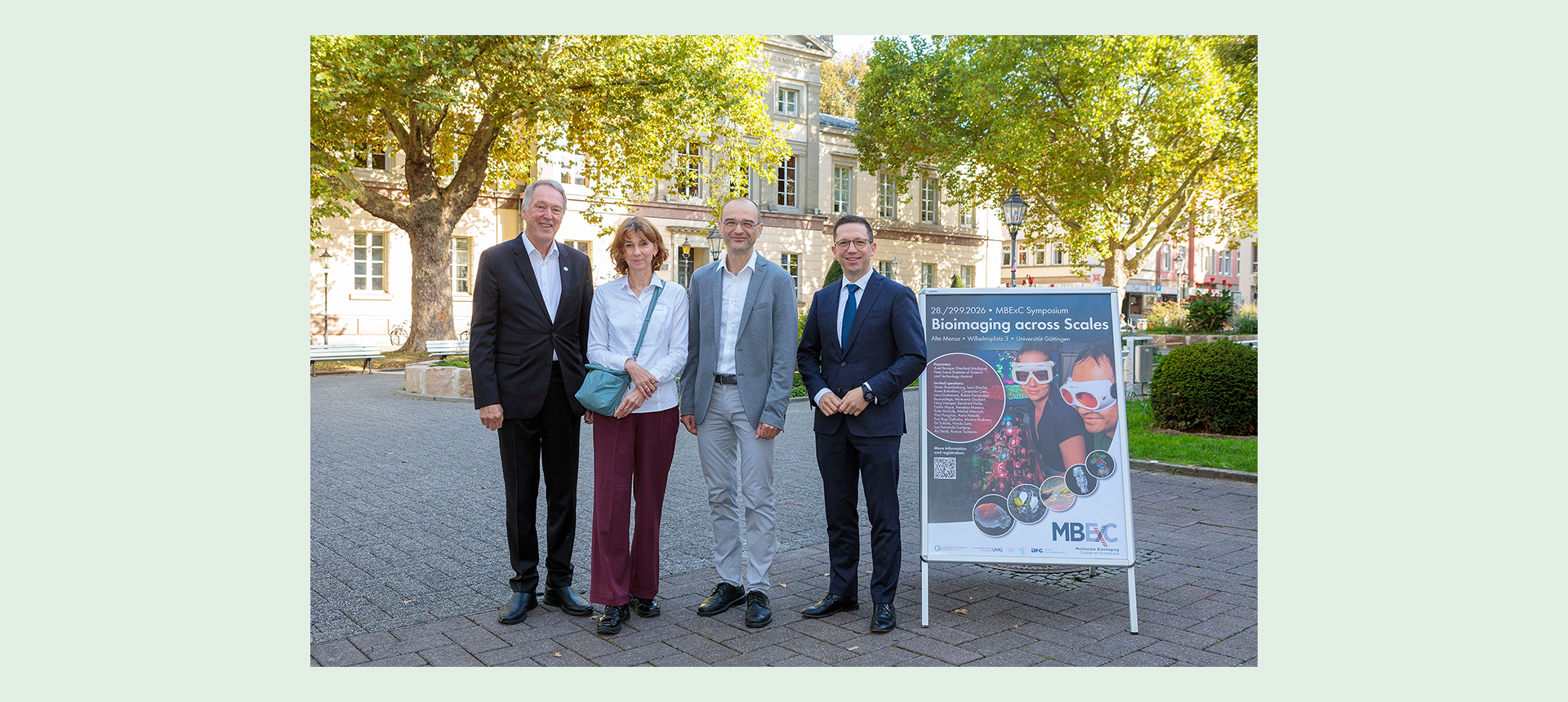
Prof. Dr. Axel Schölmerich, President of the University of Göttingen, Prof. Dr. Claudia Steinem, vize speaker of the MBExC and head of the Institute for Organic and Biomolecular Chemistry at the University of Göttingen, Prof. Dr. Tobias Moser, speaker of the MBExC and director of the Institute for Auditory Neuroscience at the University Medical Center Göttingen (UMG), as well as Falko Mohrs, Ministry of Science and Culture of Lower Saxony (v.l.n.r.). Photo: umg/ronald schmidt
