2025

Home >> 2025 >> Seite 24

Anhand eines 3D-Modells können die Forschenden den Aufbau und die Funktion der mechanischen Feder am Ionenkanal besser verstehen. Von links nach rechts: Prof. Martin Göpfert, Dr. Thomas Effertz, Dr. Philip Hehlert. (Foto: Philip Hehlert)

03.03.2025

Molekulare „Feder“ startet das Hören

Göttinger Forschungsteam gewinnt neue Erkenntnisse über den Hörsinn   Hören beginnt mit der Dehnung elastischer molekularer „Federn“, die Ionenkanäle in den Hörsinneszellen im Ohr öffnen. Dass es diese Öffnungsfedern geben muss, wussten Forschende seit Jahrzehnten, finden konnten sie diese jedoch nicht. Ein Team des Göttinger Exzellenzclusters Multiscale Bioimaging (MBExC) hat
Learn More
Feature image not available
03.03.2025

Induced Pluripotent Stem Cell Lines as a Model for Studying the Cellular Phase of Parkinson’s Disease

Authors Abdelrasol H, Outeiro TF Journal Journal of the Society of Medical Sciences of Lisbon Citation JSCMed 2025;169(1). Abstract Parkinson’s disease (PD) is a complex neurodegenerative disorder, characterized by the progressive loss of dopaminergic neurons in substantia nigra pars compacta (SNpc) as a result of intraneural deposition of aggregated alpha-synuclein
Learn More
Feature image not available
28.02.2025

Optimizing Electrical Field Stimulation Parameters Reveals the Maximum Contractile Function of Human Skeletal Muscle Microtissues

Authors Tiper Y, Xie Z, Hofemeier AD, Lad H, Luber M, Krawetz R, Betz T, Zimmermann WH, Morton AB, Segal SS, Gilbert PM. Journal American Journal of Physiology. Cell Physiology Citation Am J Physiol Cell Physiol. 2025 Feb 28. Abstract Skeletal muscle microtissues are engineered to develop therapies for restoring
Learn More
Feature image not available
27.02.2025

The keratin cortex stabilizes cells at high strains

Authors Meyer R, Rölleke U, Schwarz N, Perez-Tirado A, Schepers AV, Janshoff A, Köster S Journal BioRxiv Citation bioRxiv 2025.02.24.639846. Abstract The eukaryotic cytoskeleton consists of three filament types: actin filaments, microtubules and intermediate filaments (IFs). IF proteins are expressed in a cell-type specific manner, and keratins are found in
Learn More
Feature image not available
26.02.2025

Inhibition of the Parkinson’s Disease-Related Protein DJ-1 by Endogenous Neurotoxins of the 1,2,3,4-Tetrahydroisoquinoline Family

Authors Laurent C, Poncet G, Herskovits T, Alves de Sousa R, Le Corre L, Al-Azzani M, Koenig A, Birman S, Outeiro TF, Mansuy D, Dairou J   Journal ACS Chemical Neuroscience   Citation ACS Chem Neurosci. 2025 Feb 26.   Abstract The protein DJ-1 appears to play a protective role
Learn More
Feature image not available
25.02.2025

The plastid-encoded RNA polymerase of plant chloroplasts

Authors Ahrens FM, do Prado PFV, Hillen HS, Pfannschmidt T   Journal Trends in Plant Science   Citation Trends Plant Sci. 2025 Feb 25:S1360-1385(25)00031-7.   Abstract Plant chloroplasts possess a dedicated genome (plastome) and a prokaryotic-type plastid-encoded RNA polymerase (PEP) that mediates its expression. PEP is composed of five bacteria-like
Learn More
Feature image not available
25.02.2025

Expanding our understanding of synucleinopathies: proteinopathy, proteinopenia, and lipidopathy

Authors Flores-León M, Outeiro TF   Journal FEBS Journal   Citation FEBS J. 2025 Feb 25.   Abstract A possible consequence of the process of protein aggregation in neurodegenerative diseases is the depletion of soluble protein species (proteinopenia), which may, at least in some cases, reduce protein function/activity. This concept,
Learn More
Feature image not available
23.02.2025

Astroglial modulation of synaptic function in the non-demyelinated cerebellar cortex is dependent on MyD88 signaling in a model of toxic demyelination

Authors Lohrberg M, Mortensen LS, Thomas C, Fries F, van der Meer F, Götz A, Landt C, Rhee HJ, Rhee J, Gómez-Varela D, Schmidt M, Möbius W, Ruhwedel T, Pardo LA, Remling L, Kramann N, Wrzos C, Bahn E, Stadelmann C, Barrantes-Freer A Journal Journal of Neuroinflammation Citation J Neuroinflammation.
Learn More

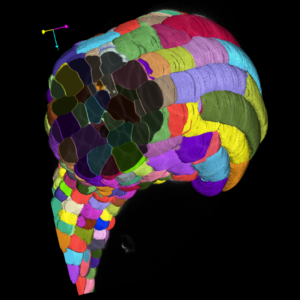
Pflanzenzellen, die mit einem Fluoreszenzmikroskop aufgenommen und mit dem Modell automatisch segmentiert wurden. Die zugrunde liegenden Daten sind dreidimensional und das Bild zeigt eine Darstellung der segmentierten Zellen, die jeweils durch eine andere Farbe repräsentiert werden. Foto: Nature Methods: s41592-021-01249-6

20.02.2025

Automatische Zellanalyse mithilfe von künstlicher Intelligenz

Internationales Forschungsteam entwickelt benutzerfreundliche Software   Um die komplexen Prozesse des Lebens zu verstehen, ist es entscheidend, einzelne Strukturen in Zellen zu erkennen und voneinander zu unterscheiden. Dieser Schritt wird als „Segmentierung“ bezeichnet und ermöglicht es zum Beispiel, die Reaktion von Zellen auf Medikamente zu analysieren. Ein internationales Forschungsteam unter
Learn More
Feature image not available
14.02.2025

Molecular Level Super-Resolution Fluorescence Imaging

Authors Radmacher N, Chizhik AI, Nevskyi O, Gallea JI, Gregor I, Enderlein J Journal Annual Review of Biophysics Citation Annu Rev Biophys. 2025 Feb 14. Abstract Over the last 30 years, fluorescence microscopy, renowned for its sensitivity and specificity, has undergone a revolution in resolving ever-smaller details. This advancement began
Learn More
X
EN DE
X
X